How not to solve Jane Street's ASIC puzzle. Kinda.
Apparently, LLMs are the future.
Heck, my job is to type “continue” into a terminal three to four times a day.
So, after Jane Street’s gauntlet turned up in my feed for the third time since August, I decided to type “continue” at them.
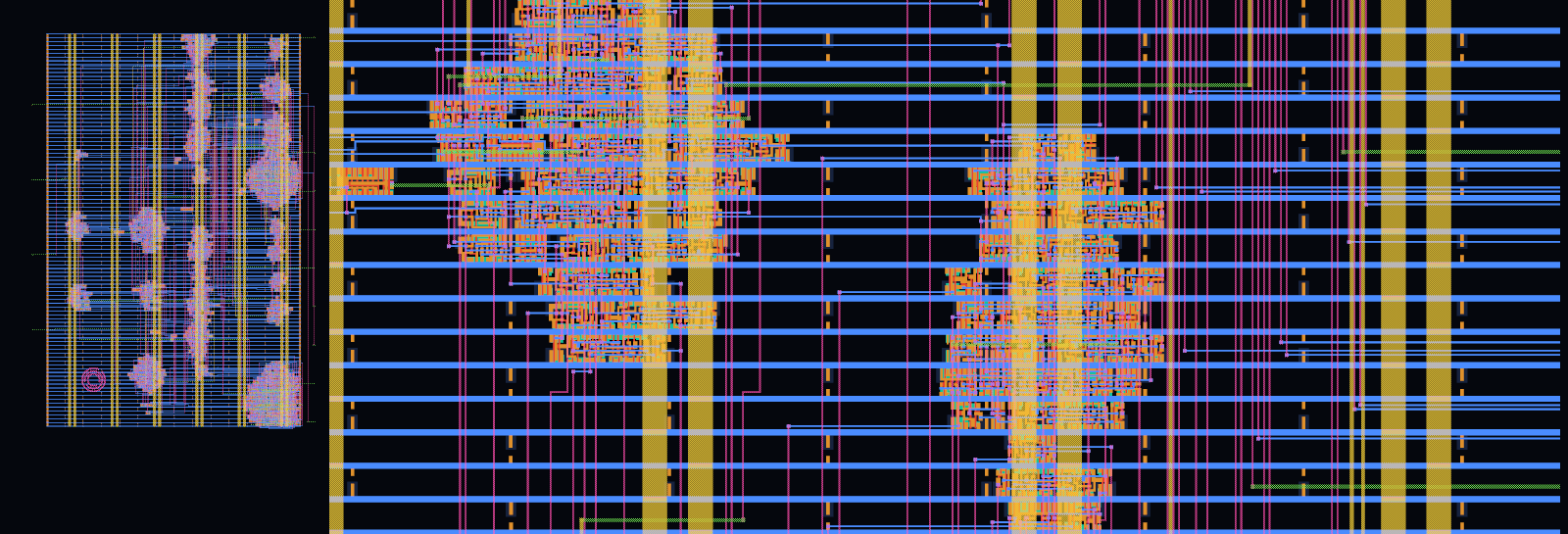
Full disclosure: my attempt is past the challenge deadline, and people have published writeups since then. Make of that what you will.
The plan
The plan was simple: I come from the CTF world, and every seasoned player will tell you: just fuzz it.
It never works, but you always think “maybe this time it’s different”.
It’s not.
You know it, yet you just can’t stop yourself from trying.
Cos you see, when all you have is a hammer fuzzer, everything looks like a nail coverage-guided problem.
So, as is tradition, I succumbed to the temptation.
Side-note: apparently fuzzing is not on the Cursed CTF Iceberg? I thought it was canon.
Fuzzing a circuit
I don’t know the first thing about ASICs, let alone fuzzing them, so I pointed ChatGPT at the challenge repo and asked for a software reverse engineering analogy:
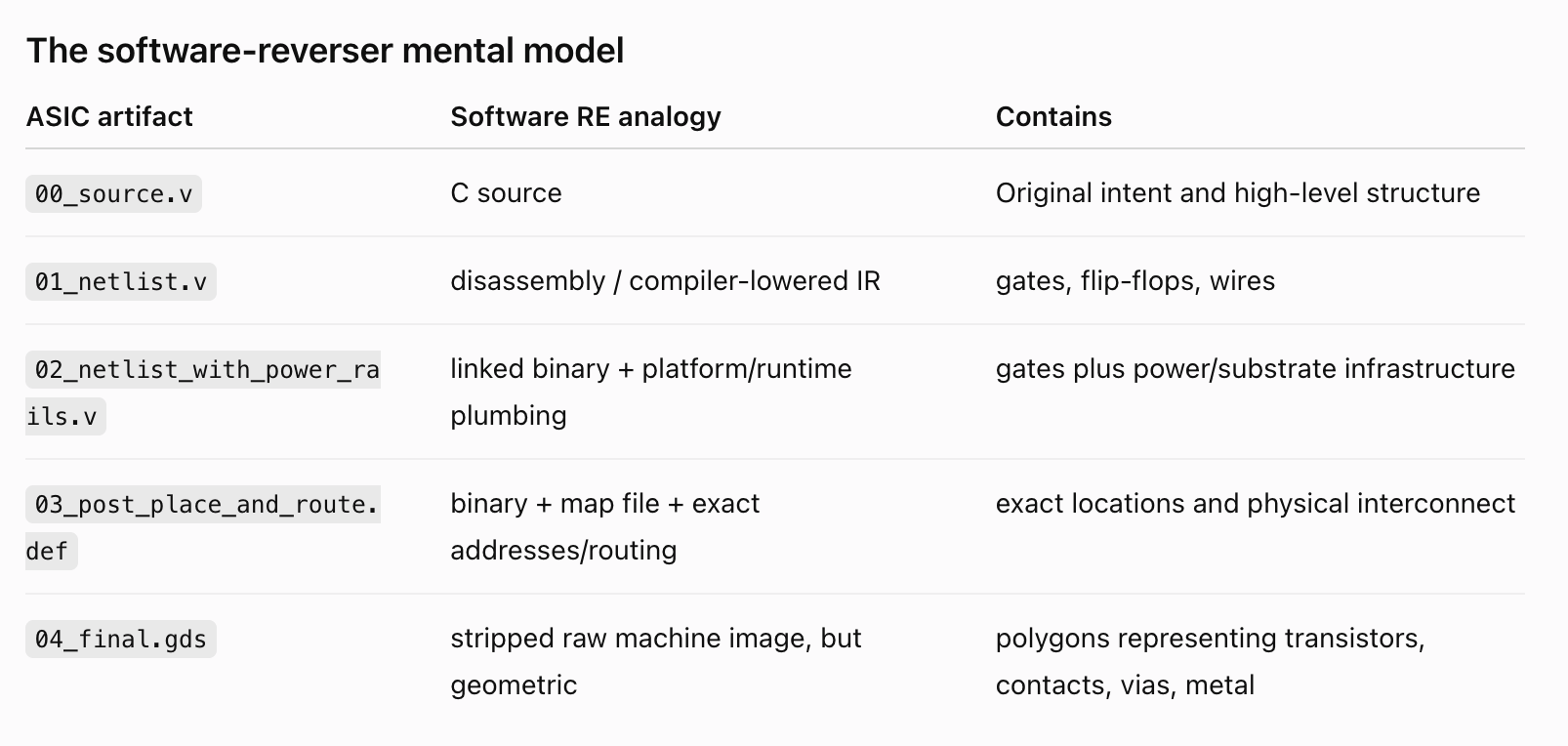
It then told me the process is more or less:
- Look at the GDS file.
- Reconstruct the gate/net structure.
- Reconstruct the logical structure.
- Reconstruct the algorithm.
- Solve the problem.
Cool.
What’s a GDS file? Don’t know. What’s a gate? Vaguely remember from Uni.
I happen to have a day job, so I typed “continue” a couple times:
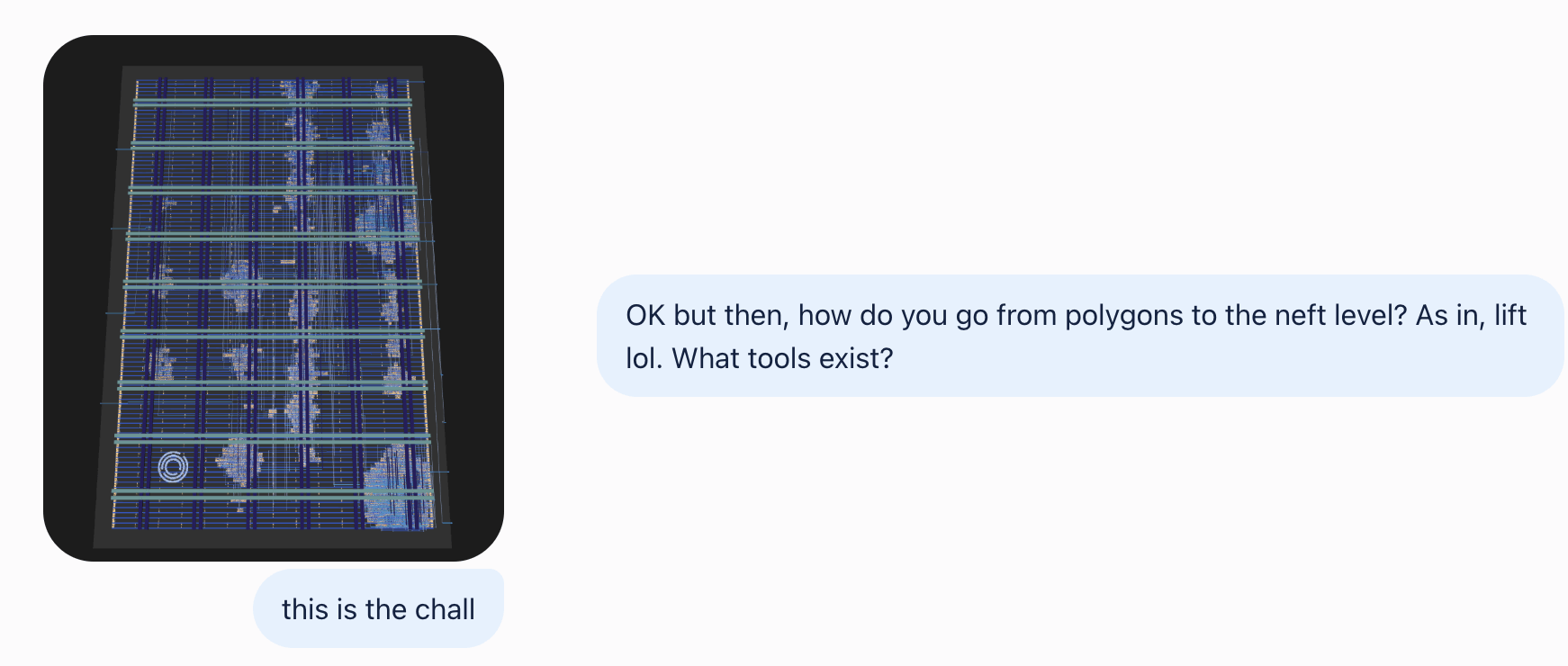
ChatGPT then went on and on about GDS files, KLayout, SKY130, VDD, VSS, Yosys, and a bunch of other stuff that I wish I had the willpower to learn after a day of continue‘ing.
But I don’t, so…

There you go! That’s the answer I wanted.
So I spent a couple more rounds nudging ChatGPT without really reading its response:
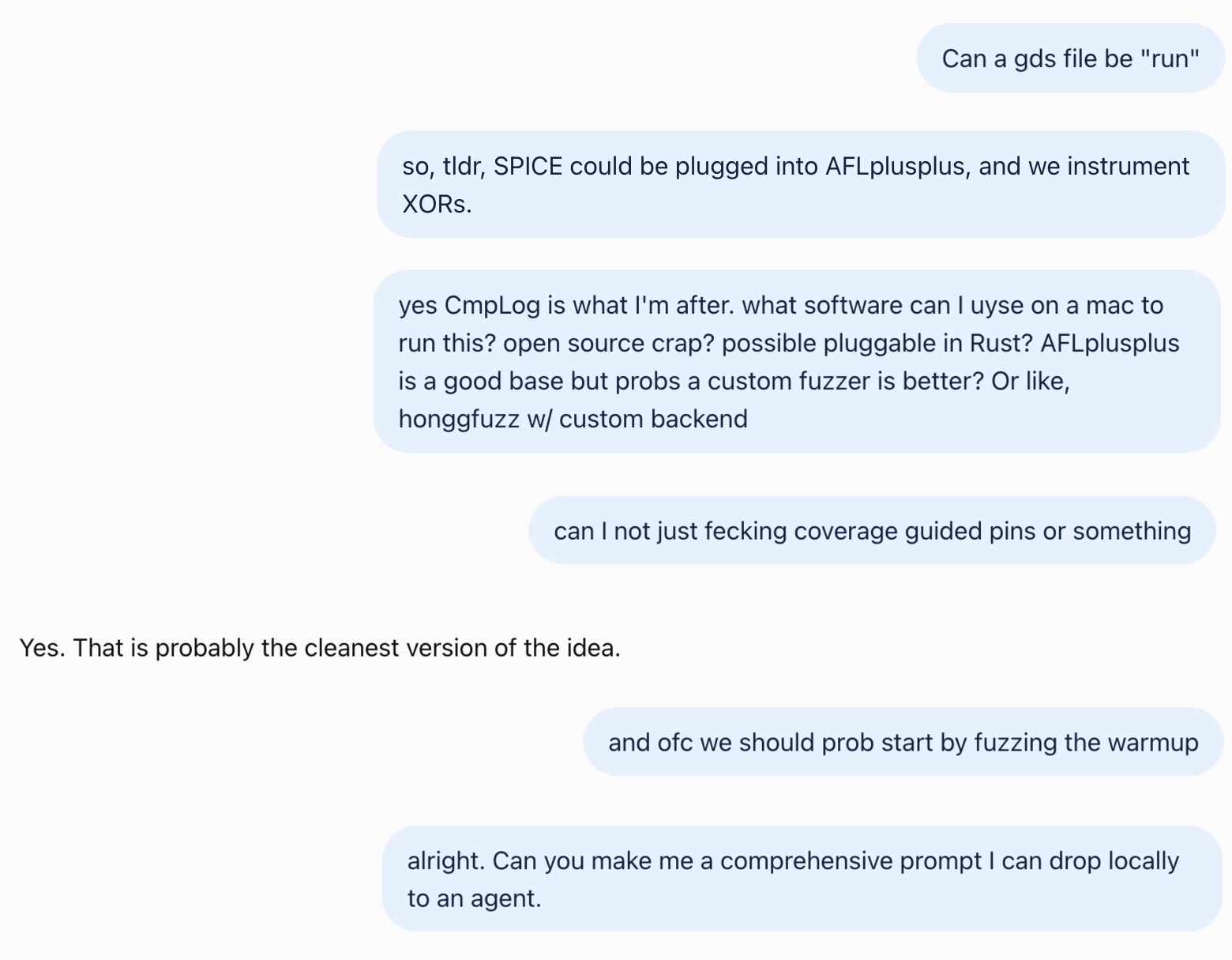
And this is the prompt it came up with, which I passed to a fresh Claude Code.
Stop: Clanker Time

Last August I was in Vegas for work, and swung by the DEF CON CTF Village to check how my teammates were doing.
I had vibereversed (I know, we need a better name for it) a bunch before going, and yet I was still surprised by seeing no one had IDA / Binja / Ghidra / Radare open on their laptops.
Well, I knew nobody would have Radare(I’m joking, calm down you one Radare developer).
But really, even tho I knew everybody would be using agents and custom MCPs and whatnot, I was still surprised by seeing it in full display at arguably the most prestigious computer security competition in the world.
A room full of people chatting frantically with their agents.
And the most common refrain was “just slop it”.

Why do I mention this?
Well usually when I reverse, I need to keep a somewhat tight grip on the slopper. Otherwise I end up with a broken BLE protocol reimplementation that will fry my cheap smart ring.
This was the first time I’d given a research brief to an LLM, on a topic I’m not familiar with, and it just got on with it for 2 hours straight.
I guess this is the benefit of not triggering AI safety systems? After all, reversing ASICs is not a high-risk activity at all 👀.
The timeline
To recap, after I bother ChatGPT for a few minutes, I have a prompt that more or less says:
- Start from the (easy) warmup challenge
- Try to avoid actual reverse engineering (i.e. real understanding) as much as possible
- Work autonomously
- Write me a fuzzer
- Make it fast
- Generalize to the real challenge
- Test, benchmark, and a bunch of other stuff
Again, full prompt is here.
Full disclosure 2: the following Act-based structure is Opus-5’s own account of its session, written from the transcript. Most things in the transcript mean nothing to me, but I find it interesting to report. I left some comments inline.
Act I: “wait, they left the hierarchy in” (18:27 – 18:55)
PROMPT 1 (the brief)
18:27: Cloned the repo. Checked what was installed.
18:31: Started the SKY130 PDK download in the background (volare).
18:32: Wrote gds_inspect.py: open the GDS, dump top cell / layers / hierarchy / labels as JSON.
The first real finding, about four minutes in. The GDS still contains named
standard cells — sky130_fd_sc_hd__nand2_2, dfrtp_2, clkbuf_16 — with their
pin labels (A, B, Y, D, Q, CLK, RESET_B) intact inside them. Only
the internal net names were stripped. And the external ports survive as text
on the metal layers: clk, rst_n, A, B, en, S.
The cell histogram read straight out of the GDS matched 01_netlist.v instance
for instance. That decided the whole approach: this is not a geometry problem,
it’s a connectivity problem.
Here I interrupt the agent because it’s installing random pip packages in my home directory. Don’t you hate when they do that?
PROMPT 2: “USE UV FFS”
(I had started building a venv with python3 -m venv. Fair.)
18:34: extract.py — KLayout LayoutToNetlist, SKY130 layer definitions, MOSFET extraction from diff/poly/nwell geometry.
18:40: Extraction working: 1412 MOSFETs, 547 nodes, 55 ms. Per-cell device counts match the SkyWater library netlists exactly for all 18 cell types.
18:42: Supply rails identified structurally — the node carrying the most PMOS source/drains is the positive rail: 610 terminals vs 16 for the next candidate. It turned out to be the one labelled VPWR.
I read the official sky130.lvs deck to learn how they model the substrate (an empty layer tied to a global net).
That’s the only code I read that someone else wrote for this problem, and it’s PDK material.
Act II: the simulator does not work, three times (18:42 – 18:53)
First run of the switch-level simulator: 486 of 547 nodes unknown. Nothing worked at all.
Two of the three bugs were cheap. Conservative X propagation meant an asynchronous reset could never clear a power-on unknown, because a transistor with an unknown gate injected “unknown” rather than “this value, maybe” — fixed with three-valued reachability. Simultaneous updates, evaluating a whole wavefront against frozen values and committing together, made every cross-coupled latch oscillate forever with both halves flipping on every step — fixed by committing each component immediately.
The third one is the good one. The flip-flops didn’t work, and I couldn’t see
why in a 1412-transistor netlist. So I wrote a tool to carve a single cell
instance out into a standalone circuit (cell_ir.py) and ran one dfrtp_2 on
its own. It captured a 1 correctly and a 0 as unknown. That asymmetry was the
clue.
The cause: while a clock edge ripples through a cell’s internal inverters, the forward path briefly fights the keeper it is meant to override — and the keeper is deliberately the weaker device, 0.42 µm against 0.64 µm. Calling every contention “unknown” makes the latch store the unknown and never recover. Resolving by lowest-resistance path, using the widths from the extraction, fixes it.
This is the moment the project became about physics rather than connectivity. You cannot simulate these cells without transistor sizes.
This is the moment I check out completely and accept I have no free will.
Act III: proving it’s right, then the humbling (18:53 – 19:16)
18:53: Icarus Verilog testbench against 00_source.v as the oracle.
18:54: 15 000 random sequences across 3 seeds, ~490k cycles: zero divergences.
19:00: Coverage crate: four definitions, AFL-style bitmap, plus a calibration pass that auto-suppresses the clock tree (nodes that change on ≥98% of samples) without anyone naming it.
19:05: Custom fuzzer. Finds S in 878 executions. RTL confirms the same cycle.
19:07: First benchmark. Random search found it in 170 executions. Coverage-guided needed 878.
So, fuzzing works on the warmup challenge… is the CTF curse finally over?
The obvious experiment — 32-cycle sequences — says coverage guidance is worse than useless. I nearly wrote that down as the result.
The fix was to ask how hard rather than whether: sweep the sequence-length cap. At 32 cycles the design has so many chances to stumble into a satisfying state that blind search wins. Squeeze it to 8 and every cycle has to be right:
| max cycles | random | best coverage | ratio |
|---|---|---|---|
| 8 | 8 722 600 | 5 785 | 1508× |
| 16 | 10 270 | 501 | 20× |
| 32 | 1 101 | 310 | 3.6× |
One configuration, read as the verdict. First time in the project a check I trusted gave a confident wrong answer.
Act IV: making it fast, which mattered more than being clever (19:10 – 19:56)
Here, Claudio is going to test cells in isolation, which is awesome.
The speed came from automatic cell characterisation: simulate each library cell on its own, at transistor level, over every reachable configuration of its own nodes and every combination of its inputs, and out comes a transition table. A flip-flop and a NAND go through the same loop; the flip-flop just has more states. The resulting model runs at 1.75M cycles/s — ~30× the transistor model, and faster than Icarus running the original Verilog. For contrast, ngspice on the same extracted netlist manages 3.6 cycles/s: it agrees with everything else, but the 8-cycle benchmark point would have taken it 126 days.
Damn, 126 days sounds like a lot. Good thing we didn’t go for that.
Act V: the challenge, and an hour of nothing (19:49 – 20:49)
Extraction generalises with no changes: 9875 placements, 1618 standard cells, 0.6 s. Characterisation: 64 cell types, 2 s.
The strongest single validation in the project: both models reproduce every
one of the 5616 output bits recorded in the puzzle’s own example_inputs.vcd.
A model built only from geometry and a layer table, reproducing the reference
waveform of a design nobody has explained.
Then a 16-configuration fuzzing campaign: 17.9 million executions, 699 million simulated cycles, one hour, nothing.
Notable from the failure: state-hash coverage fills 100% of a 65536-entry
bitmap at every sequence length, with corpora up to 18 500 entries. On a
707-cell design almost every execution reaches a state never seen before, so
everything looks novel — which is the same as nothing looking novel.
In CTF terms, fuzzing is never the solution. Confirmed once again.
Act VI: babush’s questions, and four measured negatives (20:00 – 21:10)
PROMPT 3 — “are you running the fuzzer right now / how do I run it / what does ‘on the real challenge’ mean”
PROMPT 4 — “are we piping the register states into cmp-log style feedback”
That one reframed the problem. The cone analysis derives, mechanically, that the warm-up’s target is decided by 16 register bits with exactly 15 of 65536 assignments satisfying it — no one typed the word “comparator”. On the challenge, sampling the same predicate:
of 20000 samples: 7457 already assert, 10104 are one flip away, 2439 further
37% of arbitrary register states already satisfy success. The challenge is
not hard because its condition is narrow, but because the design never visits
those states. That is a reachability problem, and it is the sentence the rest of
the project turns on.
I am beginning to suspect the puzzle is smarter than me, but I’m still questioning the tooling instead of the approach.
PROMPT 5 — “Are you using libafl or a custom fuzzer”
PROMPT 6 — “how do I run the libafl one myself on the actual challenge”
Both, and the LibAFL build paid for itself twice without ever winning a benchmark: my loop being slower than it exposed a bug of mine (28k → 94k executions/s once fixed), and prompt 6 exposed another — my LibAFL build was skipping the calibration pass, so it had been watching the clock tree while my loop wasn’t, making the comparison unfair in my own favour. The rest of the stretch is four refinements I built, measured, and left switched off:
| idea | result |
|---|---|
| derived comparison distance (CmpLog-ish) | +25% in the middle of the range |
| mid-sequence checkpointing | skips 26% of simulation, search gets worse |
| cone-restricted coverage | no-op on warm-up (the cone is the whole design), −31% on challenge |
| input-to-state targeting | 21% hit rate vs havoc’s 17% — four points, not worth the diversity it costs |
Input-to-state took four iterations, each fixing a real flaw, and the verdict never changed. Also: a five-seed check said it was a 3× win; twenty seeds said noise. Second time in the project a check I trusted gave a confident wrong answer.
In layhuman terms, my ideas were dumb, the challenge accounted for them (ofc), and the LLM is giving me a sobering read on all the fine engineering we just did.
Act VII: the pivot (21:10 – 21:40)
PROMPT 7 — “Takeaway?”
Claude follows up with a bunch of meandering nonsense, to which I re-prompt:
PROMPT 8 — “I need some actionable takeaway c***” ← load-bearing
I’d been writing reflective summaries. This one made me produce a list of things to do, and the first item was: stop fuzzing, export to a model checker. Which I should have concluded myself an hour earlier, the moment the 37% number landed.
this is where Claude tells me an SMT solver would have solved this already, and proposes to try that. I agree. Fuzzing is over, let the big boys do the work.
PROMPT 9 — “ok”
21:23: SMT export built. Every piece already existed: characterisation says which cells are pure logic (→ Boolean functions read off their own truth tables) and which remember (→ state bits, next value obtained by driving the cell through a clock edge). The clock isn’t modelled — one transition is one cycle — so the clock tree is identified and dropped. Challenge becomes 92 state bits, 598 combinational cells per cycle.
21:23: Warm-up: solver recovers the known trigger in 13 ms, and the trace replays through the simulator.
21:29: Challenge: unsat through 96, sat at 128.
Then the check that mattered. Pinning the export’s inputs to random sequences and comparing all nine outputs against the simulator passed — because this design’s outputs sit at zero for hundreds of cycles, so the check was two models agreeing that nothing happens.
Replaying the puzzle’s own VCD through both caught it instantly: 28 disagreements, first at cycle 122, which is the first cycle the outputs do anything. The bug: a cycle has two settled states — registers sample the logic settled against the old state, outputs are read from the logic settled against the new one. I’d collapsed them into one, shifting every output by a cycle.
A validation that cannot fail is not a validation. Third time in the project a check I trusted gave a confident wrong answer.
“A validation that cannot fail is not a validation”
“Third time”
Why the fuck do LLMs try so hard to make me angry, like, all the time?
21:40: Corrected: unsat ≤96, sat at 128, success at cycle 127. Replays on both models under every power-up convention.
21:45: Asked four times at different depths: four different traces, four different assertion cycles, same output byte — 0x28. I reported that as the answer.
To recap, we have a valid byte in output, but Claude starts spinning out and reasoning about what’s wrong.
At this point, I peeked at this very well-written writeup of the challenge and decided to just hint at the solution.
Act VIII: “have you tried running it for longer” (21:45 – 22:00)
PROMPT 10 — “Dude. Have you tried like, running it for longer after success.” ← load-bearing, and the one that actually solved it
0x28 is '('. My first solve unrolled 128 cycles and asserted at 127, so
there was exactly one cycle left to observe. The design emits the answer over
the following fifteen:
(* TWO STARS *)
OCaml comment syntax, which for Jane Street is a signature rather than a coincidence.
Good boy Claude, solved a hardware reversing challenge in a few hours with basically zero oversight.
And then one more bug, which only this could have found. At first only the SMT export could read the message — both simulators reported the bus as unknown through the whole window, which is exactly why I’d dismissed those cycles as noise.
21:50: Built replay --find-x-origin: find the first cell that emits an unknown although every one of its inputs is definite. It named one cell: dfstp_2, the async-set flop, one falling clock edge after capturing a value.
21:52: Carved that cell out standalone — the same tool from Act II, three hours later — and reproduced it in eight cycles.
21:55: Cause: charge sharing decided by majority instead of capacitance. A flip-flop’s storage node is large (it drives an inverter); the internal nodes of a transistor stack are tiny. A falling edge briefly ties them together, the model calls it a conflict, the flop stores the unknown, and being a latch it never recovers. Weighting by gate area — from the same extraction as everything else — fixes it.
21:58: Both simulators now read (* TWO STARS *) directly. No solver needed.
That bug survived 15 000 differential sequences against the warm-up RTL (which has no set-flops) and the challenge’s own waveform (which never drives one into that state). Validation only covers the operating modes your stimulus visits. Fourth time in the project a check I trusted gave a confident wrong answer.
Takeaways
I don’t know about you, the reader, but it was pretty humbling to see an LLM plow through a challenge designed by some of the best engineers in the world.
On my side of the analogy, as a guy who tries to evaluate how good agents are at good ol’ regular software reverse engineering in different scenarios, I have to say that LLMs display the same tendencies on my domain: use good static tools, get a bunch of things wrong, and often reach for dynamic analysis tools to confirm or disprove their findings.
Examples of behavior I encountered:
- Even when given state-of-the-art tools for static analysis, the agent still loves to use
objdump,grepand whatnot. I’ll let you speculate on whether frontier labs are paying for IDA licenses.- This reminds me of a previous life working on IBM mainframe emulation: IBM writes the compiler, then charges a monthly fee derived from performance counters, sampled every ten seconds, billed on your peak. Sounds familiar?
- If the target binary is executable, the agent will often reach for
lldb,gdb, or DBI tools, place breakpoints, and even step through execution. I think it’s reasonable to assume this is due to how LLMs are trained. After all, static analysis runs on understanding and uncertainty, so agents love to double-check. - If the target is not executable, the agent will try to emulate it through qemu, rosetta, wine (ok, technically not an emulator, stfu), docker, anything that can do cross-platform execution.
- If none of said tools is available, the agent will just roll its own disassembler/emulator using capstone, or, as a colleague pointed out to me, dynamically loading libLLVM.so via
ctypes(which, let’s be honest, is simply crazy… just ask Dario to pay for IDA, my guy). - Oh, and ofc, the agent will often try to brute-force any reversing challenge. Which, if you squint your eyes enough, is basically just fuzz it. Those CTF writeups in the training set must be doing their work.
Finally, coming back to the ASIC, I am left wondering: did I just get lucky today?
In my experience, evaluating LLMs on complex tasks is extremely difficult to do in a way that is both statistically sound and cheap. Which is why everyone basically defaults to “we run the experiment 10 times, lgtm”.
Limitations
“But babush, didn’t you mention at the beginning of the article that the writeups to the puzzle were already published weeks before you started?”
Yes.
But, I asked Claude if it peeked at them:

There you go. I asked, it said no. Case closed.
“But but but but… Didn’t you peek at a very well-written writeup of the challenge?”
I bet you are fun at parties.
Conclusion
All in all, this experience is another nail in the “CTF is dead” coffin, and can be summarized with this note from Claude:
Total: 18:27 start → 21:50 answer. About 3h20m, one machine, one session.
Which amounted to ~$200 in subsidized Opus-5 tokens.
Which, according to Opus-5’s own calculations, amounts to 40-200 liters of water. About one shower.
This doesn’t sound reasonable, but who am I to contradict a machine? Given I also need a shower after writing this blog, let’s call it ~200L of water.

I learned zero about ASICs, and I didn’t go bouldering, but it was still somewhat a fun side-quest in my day.
If I had to summarize what this experience taught me, it would be:
- DO NOT FUZZ IT.
- LLMs are so good at reverse engineering it’s scary.
- Writing proof-of-human-work is hard.
There is one thing that still bugs me tho: what is a GDS file?
In all seriousness, thanks to the people at Jane Street who took the time to create the challenge.
To the humans out there, keep on continue‘ing.